








If you’ve ever heard someone describe a purchase as a “write-off” like it’s basically free, it’s worth understanding what a business tax deduction actually does. Because it’s not a free anything.
A business tax deduction — like a personal tax deduction — lowers the amount of income the IRS taxes you on, which in turn lowers your tax bill. However, it doesn’t erase the cost of the expense itself, and not every business expense qualifies the same way. Here’s what a deduction actually is, and what it isn’t.
What Is a Business Tax Deduction?
A business tax deduction is an expense the IRS allows you to subtract from your business’s gross income, reducing the amount of income that’s subject to tax. Rather than being calculated on your total revenue, your tax bill is calculated on your taxable income, which is revenue minus your deductible expenses. As such, claiming legitimate deductions can be a major tax tip.
The core test the IRS applies to determine whether an expense qualifies is whether it’s both:
- Ordinary: Common and generally accepted in your particular trade or industry.
- Necessary: Helpful and appropriate for running your business, even if it isn’t strictly required.
An expense doesn’t have to be both essential and universal to qualify — it needs to reasonably fit the kind of spending a business like yours would normally incur. A marketing agency buying design software clearly qualifies. A bakery buying a passenger jet almost certainly wouldn’t, even if the owner could argue some business justification for it.
How a Tax Deduction Reduces Your Tax Bill
This is the part that trips up a lot of business owners: a deduction doesn’t reduce your tax bill by the full dollar amount of the expense — it reduces your *taxable income*, and your tax bill only drops by that reduction multiplied by your tax rate.
Example: Say your business has $150,000 in revenue and $40,000 in deductible expenses, and your effective tax rate is 25%.
- Without deductions, you’d be taxed on the full $150,000.
- With $40,000 in deductions, you’re taxed on $110,000 instead.
- At a 25% rate, that $40,000 deduction saves you $10,000 in taxes — not $40,000.
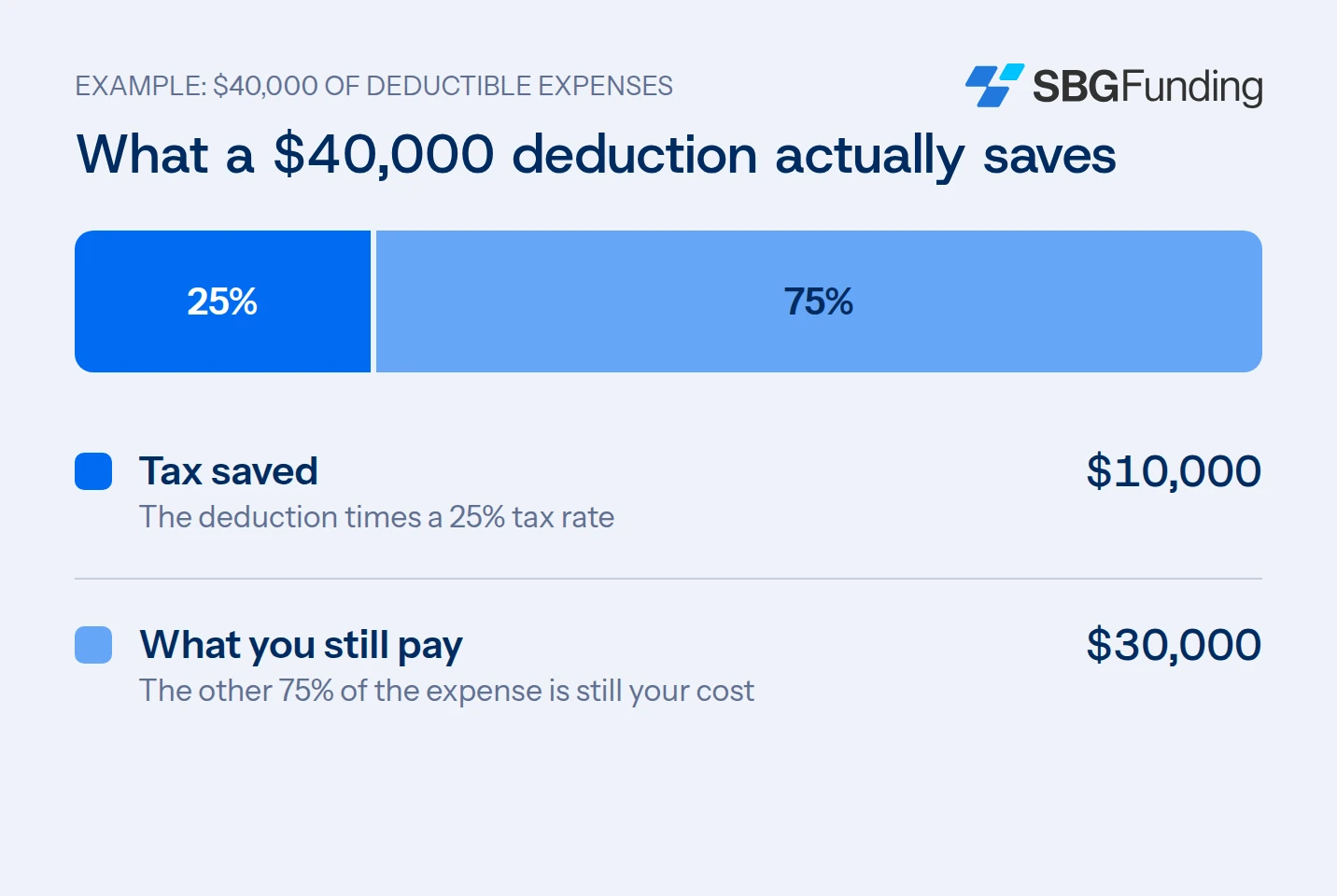
You still spent the $40,000. The deduction just means you’re not also paying tax on money you already spent running your business. It gives you a break, but it doesn’t eliminate the spending. Keep that in mind if you’re working on your budget and expecting to recoup some huge savings at tax time. Deductions save money at tax time, not upfront.
Tax Deduction vs. Tax Credit
You may have heard deductions and credits used interchangeably. They’re very different.
- Tax Deduction: Reduces your taxable income, and its value depends on your tax rate. (In the previous example, a $40,000 deduction was worth $10,000 at a 25% rate.)
- Tax Credit: Reduces your actual tax bill, dollar for dollar. A $5,000 tax credit lowers what you owe by exactly $5,000, regardless of your tax rate.
Tax credits tend to be more valuable than a deduction of the same dollar amount. Confusing the two can lead to over- or under-estimating how much a given tax break is actually worth to your business.
Not All Tax Deductions Work the Same Way
A common assumption is that any legitimate business expense is simply subtracted from income in the year you pay it. That’s true for many day-to-day expenses, but not for everything:
- Current Expenses: Things consumed within the year, like office supplies, rent, and most services, are typically deducted in full in the year they’re incurred.
- Capital Expenditures: Larger purchases with a useful life beyond one year, like equipment, vehicles, or machinery, are generally not deducted all at once. Instead, they’re usually depreciated, so the cost is spread out and deducted in portions over the asset’s useful life.
There are two notable exceptions to the capital expenditure rule. IRS Section 179 and bonus depreciation allow many businesses to deduct the full cost of qualifying equipment in the year it’s placed into service, rather than spreading it out. The eligibility rules and dollar limits change from year to year; our Section 179 guide covers how to claim it.
Common Categories of Business Deductions
A full checklist of deductions merits its own article, but we asked Manifest Wealth Management CEO, Lukendric A. Washington, JD, LLM, CFP®, RICP®, to provide us with a list of common deductions. He delivered.
- Advertising & Marketing: Website costs, digital advertising, social media marketing, business cards, sponsorships, promotional materials, and other qualifying expenses associated with promoting the business.
- Retirement Plan Contributions: Depending on the business and plan structure, contributions to a SEP IRA, SIMPLE IRA, Solo 401(k), or other qualified retirement plan may provide significant tax advantages while helping the owner and employees prepare for retirement.
- Business Vehicle Expenses: Business-related vehicle use may qualify for a deduction using either the applicable standard mileage rate or actual eligible vehicle expenses. Accurate records distinguishing business from personal use are critical.
- Home Office: Business owners who meet the requirements for regular and exclusive business use of part of their home may qualify for a home-office deduction.
- Business Insurance: Premiums for qualifying coverage, such as general liability, professional liability, commercial property, malpractice, and other business-related insurance, may generally be deductible.
- Professional Services: Fees paid to accountants, attorneys, consultants, bookkeepers, payroll providers, and other professionals for business purposes can generally qualify as deductible business expenses.
- Office Supplies, Software & Technology: Computers, software subscriptions, office supplies, cloud storage, cybersecurity services, business phone systems, and other technology used to operate the business may qualify.
- Business Travel: Qualifying airfare, lodging, transportation, and certain other expenses associated with legitimate business travel may be deductible, subject to IRS requirements.
- Business Meals: Certain meals with a legitimate business purpose may qualify for a deduction, although limitations and documentation requirements apply. Entertainment expenses generally receive different tax treatment.
- Employee Compensation & Benefits: Wages, bonuses, employer payroll taxes, and certain employee benefits can generally be deductible expenses to the business, assuming applicable requirements are satisfied.
- Rent, Utilities & Business Property Expenses: Rent for office or commercial space, utilities, internet service, repairs, maintenance, and other qualifying costs associated with operating a business location may be deductible.
Can You Deduct Business Debt?
Only the interest portion of a business loan payment is generally deductible, not the principal (more in are business debt payments tax deductible?). Principal repayment isn’t treated as an expense at all, since it’s simply returning money you borrowed rather than money you spent operating the business.
You may wonder about origination fees then. Origination fees are typically not deducted in full upfront. Rather, they’re usually amortized over the life of the loan, similar to how interest is spread across the repayment period.
This all means the tax treatment of a financed purchase can look very different from a cash purchase. It’s a good idea to model out the real cost of borrowing — including the tax breakdown — before deciding how to make a major business purchase.
How to Ensure You Get Deductions
A deduction is only as good as your ability to substantiate it if the IRS asks. Good recordkeeping habits include:
- Keeping receipts, invoices, and bank or credit card statements for every deductible expense
- Maintaining a clear separation between business and personal spending — ideally through a dedicated business bank account and credit card
- Documenting the business purpose of ambiguous expenses (like travel or meals) at the time they occur, not months later from memory
- Using accounting software or a bookkeeper to categorize expenses consistently throughout the year, rather than reconstructing everything at tax time
Most small business deductions are reported on Schedule C (for sole proprietors), Form 1120 (C corporations), Form 1120-S (S corporations), or Form 1065 (partnerships and multi-member LLCs), with depreciation specifically reported on Form 4562. The right forms depend on your business structure, so this is an area where a tax professional’s guidance is particularly worthwhile.
Explore Financing with SBG
A business tax deduction is a valuable, legitimate way to lower your taxable income and your tax bill. But it’s not a discount on the expense itself, and not every cost is deducted the same way or on the same timeline. Those distinctions matter when you’re borrowing money for your business.
If you’re weighing whether to finance an equipment purchase, expansion, or other major expense and want to understand how it could affect your taxes and cash flow, it’s worth discussing the specifics with a tax professional alongside your financing options. If financing is part of the plan, SBG Funding can help you find a structure that fits your business.
Get Started Today:
- Fill out our online application.
- Speak with a funding specialist to discuss your options.
- Submit your documents and receive funding quickly.
Typical Requirements:
- Four months of bank statements
- Driver’s license (ID)
- Voided check
- Minimum FICO score of 500, six months in business, and $150,000 in annual revenue
SBG Funding can help you find the right funding for your business.
FAQs
Usually nothing. “Write-off” is an informal way of saying tax deduction.
Generally, no. Most business meals are limited to a 50% deduction under current rules, though there have been temporary exceptions in past tax years.
It’s not a strict legal requirement, but it’s a good idea. Mixing personal and business expenses makes it much harder to substantiate deductions and increases the risk of errors or disputes if you’re audited.
It’s usually not a good idea to make a purchase just for a tax deduction. Since a deduction only offsets a percentage of the cost (based on your tax rate), you’re still paying the majority of the expense. You should make purchases because they make business sense, but the tax benefit may be a secondary consideration.