








When a small business sells to a larger company, it often does the work, ships the product, and then waits 30, 60, or even 90 days or more to be paid. Operating expenses don’t stop during that time. The business still has to cover payroll, materials, rent, and other costs.
Supply chain financing was built to close the gap between when a contract is fulfilled and when it’s paid. It’s a term that gets used loosely, though, and the version most business owners need to understand is very different depending on whether you’re the supplier waiting to be paid or the buyer setting the terms.
This guide explains how supply chain financing works, what it costs, who it helps, and what to do if the large buyers you sell to don’t offer it.
What Is Supply Chain Financing?
Supply chain financing is a set of financing arrangements designed to speed up cash flow between buyers and their suppliers. It’s essentially a form of cash flow financing. In its most common form, it works like this: a buyer approves a supplier’s invoice, a bank or finance company pays that invoice to the supplier early (minus a small discount), and the buyer then pays the finance company on the original due date.
Because the lender is ultimately being repaid by the buyer, the pricing is generally based on the buyer’s business credit score rather than the supplier’s. A large company with good credit can usually borrow far more cheaply than a small supplier can, so the supplier effectively gets to “borrow” at the buyer’s rate.
Ali Zane, CEO of Imax Credit Repair Firm, sums it up thusly: “Supply chain financing programs are relatively simple. A business signs or orders goods or services, just as it always did. The seller approves the invoice, just as it always did. The buyer then approves the invoice. But instead of going to the buyer’s finance department for payment, the invoice goes to a bank.”
This is why the most common form is also called reverse factoring. It’s backward from the traditional factoring model, in which the supplier initiates the process. In reverse factoring, the buyer starts the process.
How Does Supply Chain Financing Work?
The step-by-step process of the most common form of supply chain financing looks like this:
- The buyer sets up a program: The buyer partners with a bank or finance platform and invites its suppliers to participate.
- The supplier delivers goods or services: Once delivered, they submit an invoice as usual.
- The buyer approves the invoice: This approval confirms the invoice is valid and will be paid on its due date, which is what gives the lender confidence.
- The supplier chooses whether to get paid early: It can wait for the normal due date, or take early payment from the finance provider at a discount.
- The lender pays the supplier: After approval, the financier issues payment within a few days.
- The buyer pays the lender: On the original due date, the buyer pays back the lender, with no change to the buyer’s payment schedule.
Let’s look at an example.
Say a supplier sends a $100,000 invoice to a large customer on net-90 terms. The customer approves it, and the supplier opts for early payment on day 10, 80 days ahead of the due date. To round out the final numbers, we’ll use a 360-day year.
- Through the buyer’s program, with a discount rate of 6% annualized: $100,000 × 6% × 80/360 ≈ $1,333 discount. The supplier receives about $98,667 now.
- On its own, if the supplier had to borrow against that receivable at 14% annualized due to their less impressive credit: $100,000 × 14% × 80/360 ≈ $3,111 in financing cost.
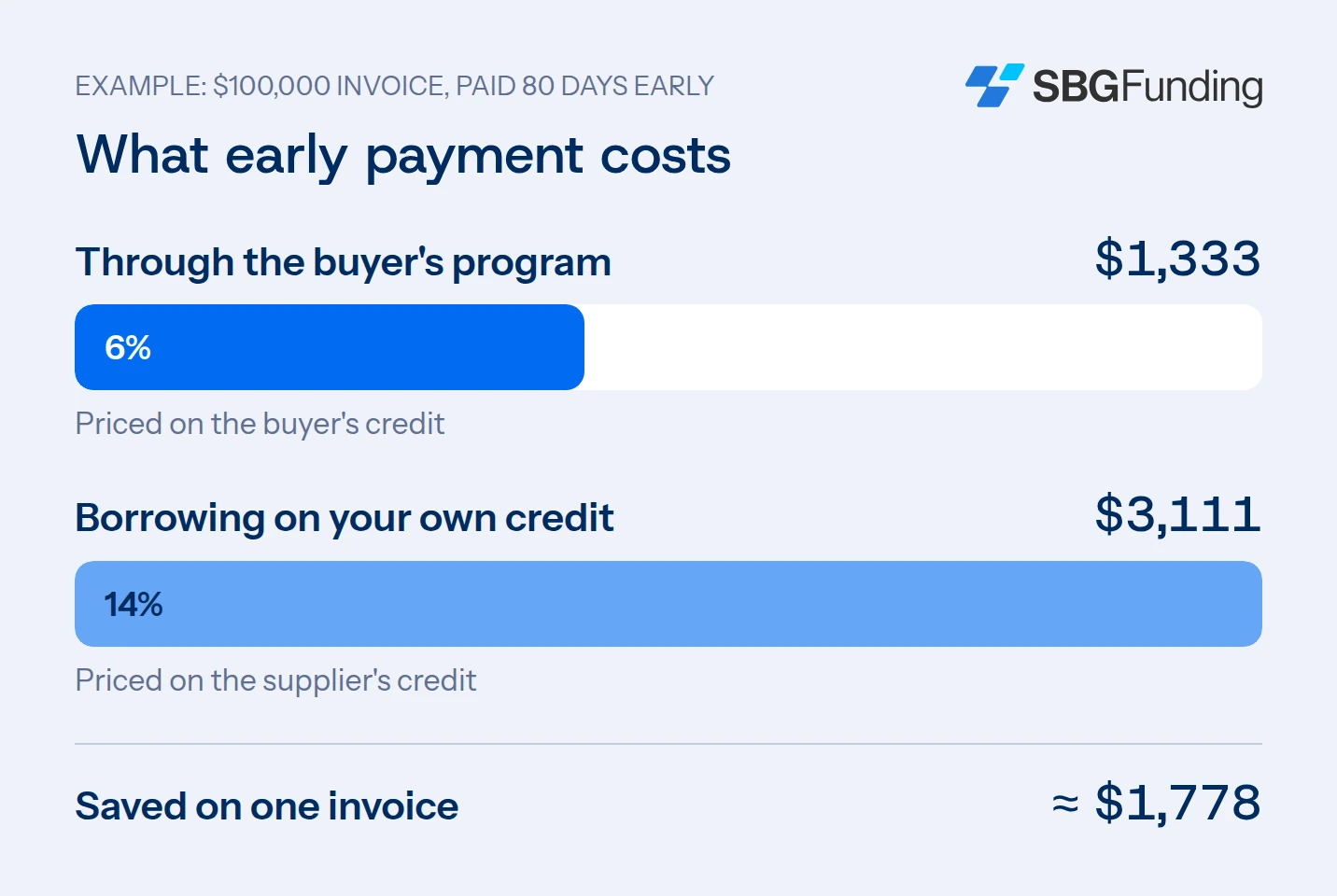
The supplier saves roughly $1,800 on a single invoice and gets its cash 80 days sooner. Multiplied across dozens of invoices a year, the difference is significant. Discount rates will vary by buyer, program, and market conditions, but you get the idea.
Supply Chain Financing vs. Invoice Factoring vs. Invoice Financing
These terms are often used interchangeably, but they work differently:
| Supply Chain Financing (Reverse Factoring) | Invoice Factoring | Invoice Financing | |
|---|---|---|---|
| Who initiates | The buyer | The supplier | The supplier |
| Pricing based on | Buyer’s credit | Supplier’s customers’ creditworthiness and the supplier’s profile | Supplier’s business and receivables |
| How it works | Lender pays approved invoices early; buyer repays lender | Supplier sells invoices to a factor, which collects from customers | Supplier borrows against unpaid invoices and stays in control of collections |
| Customer involvement | Buyer approves invoices and participates | Customer typically pays the factor directly | Often not visible to the customer |
| Access | Only if the buyer offers a program | Available to the supplier independently | Available to the supplier independently |
Supply chain financing usually offers the lowest cost, but you can’t start it yourself. Invoice factoring and invoice financing are tools you control.
Types of Supply Chain Financing
We’ve mentioned that supply chain financing could refer to a number of different things. Reverse factoring is the most common type, but other types of supply chain financing include:
- Dynamic discounting: The buyer pays suppliers early out of its own cash in exchange for a discount that grows the earlier it pays. No outside lender is involved.
- Purchase order (PO) financing: A lender funds the cost of fulfilling a confirmed customer order, helping suppliers buy materials or inventory before they’ve been paid.
- Inventory financing: Funding secured by inventory, helping manufacturers and distributors stock up ahead of demand.
- Distributor or dealer financing: Financing offered to the buyers of a manufacturer’s products, so they can purchase inventory and pay over time.
The right one for your business depends on where in the cash flow cycle you’re having issues: before you deliver (PO financing), while goods sit in stock (inventory financing), or while you wait for payment (reverse factoring and invoice-based options).
Benefits of Supply Chain Financing for Suppliers
- Faster access to cash: Payment in days instead of months, which shortens the cash conversion cycle.
- Lower financing costs: Pricing reflects the buyer’s credit, which is typically stronger than a small supplier’s.
- Predictability: Once an invoice is approved, the payment timing is firm, making cash flow easier to forecast.
- Less strain on credit lines: Early payment can reduce how much you need to borrow elsewhere for working capital.
- Easier growth: Taking larger orders from big customers becomes more manageable when you aren’t carrying the cost of long payment terms.
Benefits of Supply Chain Financing for Buyers
- Longer payment terms: Suppliers can still get paid early, buyers just get a longer ramp.
- Stability: There’s a more stable supply chain, because suppliers with healthy cash flow are less likely to hit disruptions.
- Stronger relationships: Successful supply chain financing can build trust and, sometimes, get better pricing.
- Organization: Streamlined payables through a single platform for approving and tracking invoices.
Risks and Drawbacks of Supply Chain Financing
While there are many positives for supply chain financing for both buyers and suppliers, there are still risks and drawbacks. These may include:
- Dependence on one buyer’s program: The buyer controls whether the program exists, who’s eligible, and what the terms are. If the buyer changes providers, tightens eligibility, or ends the program, your access can disappear, sometimes with little notice.
- Pressure toward longer payment terms: Buyers sometimes use these programs to stretch payment terms significantly. If you come to rely on early payment at a discount, a longer standard term can leave you worse off than before if the program is later withdrawn.
- Concentration risk: If a large share of your financing runs through one buyer’s program, a problem with that buyer or the program provider hits you hard. For example, the 2021 collapse of Greensill Capital, a major supply chain finance provider, left suppliers and buyers scrambling and drew regulatory attention to the sector.
- Discount costs still apply: Early payment isn’t free. The discount is usually cheaper than alternatives, but you should compare it against your other options each time.
- Disclosure and accounting scrutiny for buyers. Because these programs can look like borrowing, accounting standards now require buyers to disclose certain details about supplier finance programs, and auditors and lenders pay attention to them. Buyers should work with their accountants on how a program is presented.
Zane says, “Supply chain financing is not a cure-all. For as many advantages as it offers, particularly to smaller companies, it comes with risks as well. Loans have to be repaid. Factoring involves fees that can eat into the profit margins. Today’s buyers are often tomorrow’s suppliers. How you treat those relationships matter and in the small business universe, a little bad word-of-mouth goes a long way.”
Who Is Supply Chain Financing Best For?
Supply chain financing isn’t right for every business. It tends to work best if:
- You sell to large, creditworthy buyers that already run a program, which is more common in manufacturing, retail, healthcare, and large corporate supply chains.
- You regularly face payment terms of 60 days or more that strain your working capital.
- Your invoices are recurring and predictable, which makes participation easy to build into your routine.
It’s less useful if your customers are mostly small businesses or consumers, or if no buyer you work with offers a program.
“My recommendation to business owners is to see financing as an operational tool rather than as a last-resort option,” says Steve Jafari, CEO of Restoration Doctor in Florida. “I would want to look at the terms of the financing, including the fee, payment terms, and how the financing might impact my profit margins.”
Supply Chain Financing Alternatives
Most small businesses don’t have a buyer-led program available, and that’s fine. You can get much of the same benefit through a range of financing options:
- Invoice financing or factoring: Allows you to access cash tied up in unpaid invoices without waiting out the payment terms.
- Business line of credit: Helps you cover recurring timing gaps between paying suppliers and collecting from customers, and gives you a flexible, revolving source of capital when you need it.
- Purchase order financing: If the gap occurs before you deliver, PO financing can help you buy materials to fulfill a large order.
- Negotiating your own terms: Ask your customers for shorter payment terms or deposits, and ask your suppliers for longer ones, to narrow the gap from both sides.
Tracking your average days to payment and keeping clean invoicing records makes each of these easier, and helps lenders evaluate you quickly.
Explore Financing with SBG
Supply chain financing lets suppliers turn approved invoices into cash within days by borrowing against their customer’s credit instead of their own. It can be a low-cost way to relieve the strain of long payment terms, but because the buyer controls the program, it’s a tool you can use rather than one you can build. If your customers offer it, evaluate the terms carefully and avoid becoming overly dependent on it.
If they don’t, SBG Funding offers a range of financing options to help you cover your operational needs.
Get Started Today:
- Fill out our online application.
- Speak with a funding specialist to discuss your options.
- Submit your documents and receive funding quickly.
Typical Requirements:
- Four months of bank statements
- Driver’s license (ID)
- Voided check
- Minimum FICO score of 500, six months in business, and $150,000 in annual revenue
FAQs
Usually not in the traditional sense. In reverse factoring, the supplier is effectively selling an approved receivable at a discount rather than borrowing, though how it’s treated for accounting and legal purposes depends on the structure and the parties’ circumstances.
Reverse factoring is the most common form of supply chain financing, and the two terms are often used interchangeably. Supply chain financing can also refer to a broader range of related financing options, such as dynamic discounting and purchase order financing.
Generally, no. Buyer-led programs are typically established by larger companies with strong credit. A small business can, however, use alternatives, such as invoice financing, factoring, purchase order financing, or a line of credit.
Costs vary based on the buyer’s credit rating, the length of time between early payment and the original due date, and market interest rates.