








Sometimes, a more efficient way to grow is by acquiring another business rather than scaling your own operations. But financing a business acquisition or buyout works differently than financing a startup or funding growth in a business you already know. The deal size is often larger, the structure more layered, and you may have more than just one financing source.
Business acquisition financing is the money a buyer uses to purchase an existing company or buy out an owner’s stake. Most small business acquisitions combine several sources: the buyer’s own cash (the equity injection), an SBA 7(a) or bank loan, and often a seller note.
Understanding how these pieces fit together can make all the difference between a successful deal and one that stalls before the finish line.
Why Does Acquisition Financing Work Differently?
When you’re financing growth in your existing business, you’re usually borrowing against your own track record. When you’re financing an acquisition, you’re borrowing against a lesser-known variable. Your application is evaluated based on that business’s financials and assets, as well as your own qualifications as a business owner. As such, many business acquisitions involve the seller themselves playing a role in the financing.
The Main Sources of Acquisition Financing
There are several types of business loans and funding mechanisms that may be used for acquisitions.
SBA Loans
For most business owners, the U.S. Small Business Administration (SBA) is the most attractive financing option for acquiring a business. SBA loans are partially guaranteed by the government, which allows banks to offer more favorable terms than they’d find from conventional lenders, such as lower down payments and longer repayment terms.
SBA 7(a) financing is the most commonly used tool for small business acquisitions under $5 million, the 7(a) program maximum. Buyers typically need to inject at least 10% of the total project cost as equity, with the remainder financed through the loan.
Business Loans
Small business term loans from banks, credit unions, or online lenders can be useful assets for business acquisitions. Conventional lenders tend to have higher loan limits and lower interest rates, but slower application processes and stricter eligibility requirements. You may need strong credit, a large down payment, and more collateral than either an SBA loan or loan from an online lender.
Seller Financing
Also called a seller note, seller financing is exactly what it sounds like: the seller agrees to finance a portion of the purchase price themselves, with the buyer repaying them over time.
Seller financing agreements are separate from any bank or SBA financing involved, but don’t preclude being able to use that financing. It’s actually very common that small business acquisitions involve some degree of seller financing.
“For smaller local businesses, traditional banks often won’t touch a deal because there isn’t enough physical real estate or corporate collateral to back it. That’s why seller financing is usually the real engine of small acquisitions,” says Zack Nienaber, owner of Nienaber And Sons Lawn Care L.L.C. in Ohio.
Sellers offering financing are also showing their confidence in the business’s ongoing ability to generate the cash flow needed to repay them, which can itself be a reassuring sign to a bank financing the rest of the deal.
Retirement Fund Rollovers (ROBS)
A Rollover for Business Startups (ROBS) arrangement allows a buyer to use funds from an eligible retirement account (like a 401(k) or IRA) to finance a business purchase, without triggering the early withdrawal penalties or income tax that would normally apply to tapping retirement funds early.
A ROBS deal works by rolling the retirement funds into a new C-corporation retirement plan that then invests in the acquired business. ROBS arrangements come with specific IRS and Department of Labor compliance requirements and are usually set up through a specialized provider rather than independently.
Importantly, they’re risky. The funds used are retirement savings, not a bank loan. It’s a major investment from your personal finances into a business, so you shouldn’t venture down this road without discussing with a financial advisor with specific experience in ROBS structures.
Personal and Home Equity Financing
Some buyers, particularly for smaller acquisitions, use a personal loan, home equity loan, or home equity line of credit (HELOC) to fund part of a business purchase. This can simplify the financing process, but it directly ties the acquisition to your personal assets and financial exposure. If the acquired business struggles, you could be putting your home at risk if you put it up as collateral for the loan.
Bridge Loans
With a bridge loan, short-term financing (typically 6 months to 2 years) is used to close a deal quickly while longer-term financing is still being finalized. Bridge loans are priced for speed rather than affordability — often carrying higher rates than a standard acquisition loan — and are generally used when you need to close a deal faster than you can arrange permanent financing. SBG Funding offers bridge capital from $5,000 to $10 million for this situation, such as covering a seller’s deadline while your SBA financing is still weeks from closing.
How to Combine Financing for Business Acquisitions
Very few acquisitions are financed through a single source end-to-end. There are many ways companies get money for acquisitions, so it may not be surprising that deals are usually structured with a few layers of financing.
Let’s look at an example of a $1.5 million acquisition:
- Buyer equity injection (down payment): $150,000 (10%)
- Seller note: $225,000 (15%), repaid to the seller over 5 years
- SBA 7(a) loan: $1,125,000 (75%), covering the remainder
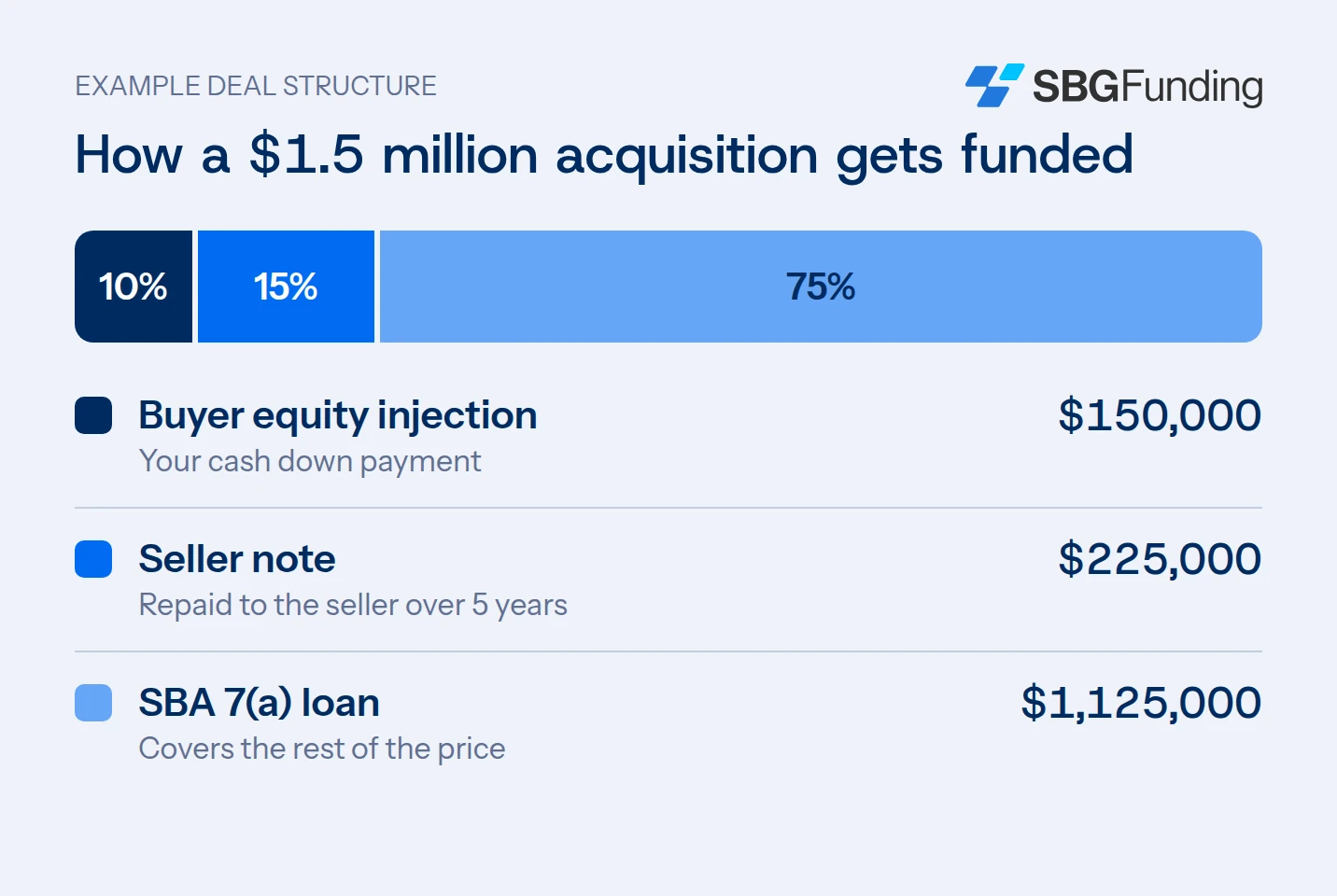
In this structure, seller financing reduces the amount the buyer needs to bring in cash or borrow from a bank, while the SBA loan’s government guarantee makes the bank more comfortable financing the majority of the deal. Note that under the SBA’s current rules, a seller note only counts toward your 10% injection if the seller takes no payments for the full term of the SBA loan, and even then it can cover no more than half of it. A seller note repaid on a normal schedule, like the one above, comes on top of the buyer’s 10%.
Many small business acquisitions are structured like this because it balances the reality of a buyer’s limited available cash against the bank’s need for security and the seller’s interest in maximizing their sale price. It’s a win-win-win.
Larger deals might add a private equity or investor layer on top of this structure, while smaller ones may skip the bank financing and work directly with the seller. Nonetheless, the point is the same: business acquisitions are rarely as cut-and-dry as a simple small business loan.
What to Do Before You Apply for Acquisition Financing
Having a sense of business acquisition financing is a good start, but there are important steps to take before you begin your financing strategy:
- Get an independent business valuation: Lenders will want to see that the purchase price is reasonably justified by the business’s financials, not just the seller’s asking price.
- Review the target business’s financials: Work with an accountant experienced in merger & acquisition (M&A) due diligence. Lenders will check whether the business’s cash flow comfortably covers the new debt payments, its debt service coverage ratio. Messy or inconsistent seller financials can slow down or complicate underwriting, regardless of how good the underlying business actually is.
- Understand your own qualifications: For SBA loans in particular, your relevant experience and management plan for running the business are part of what’s being evaluated, not just the business’s own numbers. Expect to sign a personal guarantee if you’ll own 20% or more of the business.
- Line up your equity injection: Knowing where your portion of the down payment is coming from before you’re deep into a deal avoids a scramble that can jeopardize your timeline.
- Talk to a lender before you have a signed letter of intent: Understanding what a lender would actually be willing to finance, and at what terms, helps you structure a realistic offer rather than negotiating a deal you later discover is difficult to finance.
Remember, you shouldn’t tie up so much money in the acquisition that you won’t have any left over to run the business. “Financing is only half the battle,” says Nienaber. “The real trick in a small service acquisition is making sure the funding structure leaves enough working capital on hand to keep trucks rolling and technicians paid from day one, without choking the business with heavy upfront debt service.”
How to Choose the Right Financing for Your Business Acquisition
The right financing for a business acquisition depends on your available funds, the business itself, and your timeline. These scenarios can guide your decision-making:
- For most small business acquisitions under roughly $5 million: An SBA 7(a) loan combined with a seller note and equity injection is the most common and often most accessible structure.
- For larger acquisitions or deals with significant growth potential: You may want to explore private equity or investor capital rather than working with a bank.
- For time-sensitive deals where permanent financing isn’t yet finalized: A bridge loan can close the gap, provided you have a clear, realistic plan for the longer-term financing that will replace it.
Explore Financing with SBG
Financing a business acquisition rarely comes down to a single loan. More often, it’s a structured combination of buyer equity, SBA financing, and seller financing. The right mix depends on the deal’s size, the target business, and your own financial position.
If you’re structuring financing for a business acquisition and want to understand how SBA 7(a) financing or bridge capital could fit into your capital stack, SBG Funding can help you look at what’s available.
Get Started Today:
- Fill out our online application.
- Speak with a funding specialist to discuss your options.
- Submit your documents and receive funding quickly.
Typical Requirements:
- Four months of bank statements
- Driver’s license (ID)
- Voided check
- Minimum FICO score of 500, six months in business, and $150,000 in annual revenue
Sometimes, the fastest way to grow is through an acquisition. SBG Funding can help.
FAQs
It depends on the financing, but SBA 7(a) loans usually require a 10% buyer equity injection, while conventional bank financing may require 20% or more. Seller financing can sometimes reduce the amount of cash you personally need to bring to closing.
Seller financing isn’t a red flag. It’s one of the most common ways that small business acquisitions are financed, and it can actually be a positive signal, since a seller willing to finance part of the deal is typically expressing confidence in the business’s ongoing performance.
Yes, through a properly structured ROBS arrangement, though it involves specific compliance requirements and is generally set up through a specialized provider rather than independently. You should discuss it with a financial advisor with ROBS experience before pursuing.
There are many potential hurdles in business acquisitions, but one of the most common mistakes is financing the purchase so tightly that you don’t have any working capital left to operate the business after closing.